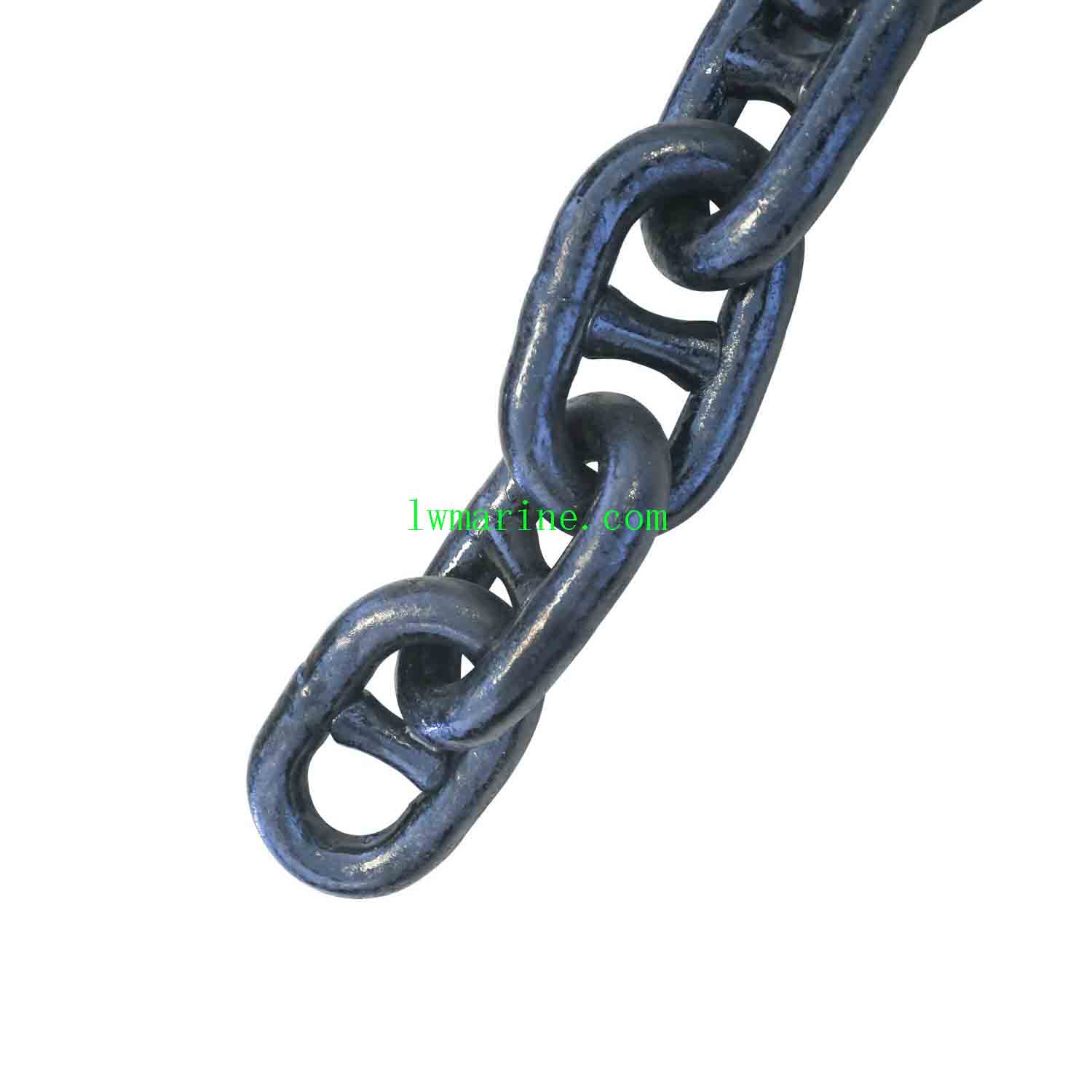
Anchor Chain
Welcome to the most comprehensive resource for marine anchor chains and accessories. Understanding the different types of anchor chains, their construction, and their specific applications is critical for the safety and reliability of any vessel or offshore installation. We provide a full range of high-quality chains and fittings to meet the diverse needs of the global maritime industry.
Anchor chains are the critical link between a vessel and its anchor, and their selection depends on factors like vessel size, operational environment, and regulatory requirements. The structure of its links is the primary method of classification: Stud Chain and Studless Chain.
-
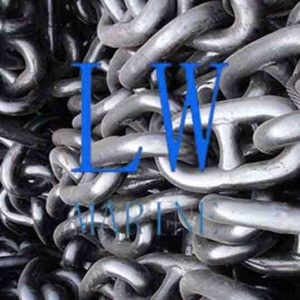
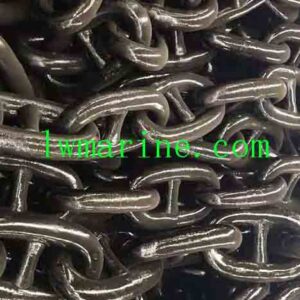
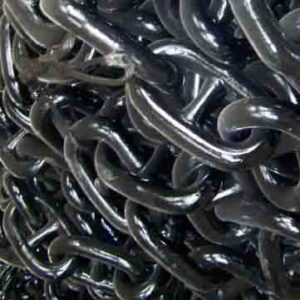
Stud Link Anchor Chain: The chain link of a stud link anchor chain is equipped with a solid bar (the stud) across the center. When the size and material are identical, the strength of a chain with the stud is significantly greater than that of a chain without. The stud prevents the link from deforming under extreme load and improves handling through the windlass.
-
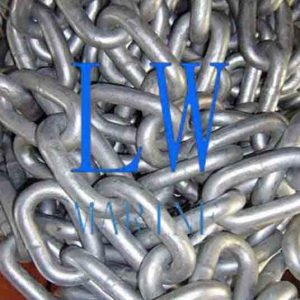
Studless Anchor Chain: A gearless anchor chain (or open link chain) has no rungs. It is lighter and more flexible but has a lower breaking load than a stud link chain of the same diameter. Regulations often stipulate that when the required anchor chain diameter does not exceed 17mm, it may be replaced by a studless anchor chain with the same test load, or even by high-strength steel wire rope or fiber rope with an equivalent breaking load.
Manufacturing Methods: Cast, Welded & Forged
Anchor chains are also categorized by their manufacturing method:
-
Cast Steel Anchor Chain: Offers high strength, good rigidity, minimal deformation, and excellent wear resistance. The crosspiece is not prone to loosening, leading to a long service life and suitability for mass production. The disadvantages are a complex manufacturing process, higher cost, and poorer impact resistance compared to forged chains.
-
Electric Welding Anchor Chain (Flash Butt Welding): Made from high-quality round steel and joined using advanced welding techniques. This method has the advantages of a simple, advanced production process, lower cost, and excellent, consistent quality. Today, electric welding anchor chain (specifically flash butt welding) is the most widely used method on commercial vessels, and cast chains are now rarely used for primary anchoring.
-
Forged Anchor Chain: Possesses good impact toughness but involves a complicated manufacturing process, high cost, and potentially unstable quality. With the exception of some anchor chain accessories which are still forged, the use of forged anchor chain for the main chain has been largely eliminated.
Steel Grades & Classification
The steel grade used in anchor chain production is a key indicator of its tensile strength and performance.
-
For electric welding chains, steel grades are divided into three levels: M1, M2, and M3.
-
For cast steel anchor chains, grades are M2 and M3.
-
In specifications, an “A” preceding the code (e.g., AM2) indicates a stud link chain. A “B” (e.g., BM1, BM2) indicates a studless chain.
-
AM1 grade steel is killed steel. AM2 and AM3 grade steels are fully killed and fine-grained, offering enhanced properties.
-
The higher the steel grade (e.g., M3 vs. M2), the greater the tensile strength. For the same vessel, using higher strength steel allows for a potential reduction in the chain link diameter, saving weight.
The Composition of an Anchor Chain
A complete anchor chain is composed of many individual links connected to form a shackle (a standard length, typically 27.5 meters). Several shackles are then connected using special joining links or shackles to form the entire anchor chain length.
Anchor Chain Links & Components
Each component in the chain has a specific name and function. The size of each link is represented by the diameter (d) of the round steel from which it is made.
-
Common Link (C): The most numerous link, characterizing the chain’s size and strength. The chain diameter (d) refers to the diameter of the common link. For a standard stud link, typical proportions are: diameter d, width 3.6d, length 6d.
-
Enlarged Link (EL): Serves as a size transition. Its dimensions are typically 10% larger than the common link in the same chain.
-
End Link (E): An enlarged, open link used at the ends of a chain section to facilitate connection. Its diameter is typically 1.2d.
-
Swivel (SW): A component designed to prevent twisting of the chain, reducing stress and wear.
-
End Shackle (ES) – D Type: The final link that connects the anchor chain directly to the anchor’s crown shackle. It has a diameter of approximately 1.4d for strength.
-
Detachable Joining Link / Kenter Shackle (KS): Used to connect two lengths (shackles) of chain. The Kenter Shackle (or Kent-type) is a common, detachable link with a diameter equal to the common link (d), allowing it to pass through a windlass gypsy. It consists of two interlocking halves secured by a tapered pin.
-
Joining Shackle (JS): A detachable D-shaped shackle used for connections, often where a Kenter link is not suitable. To ensure strength, its diameter is increased (e.g., to 1.3d) and it connects to enlarged end links on either side.
The horizontal pin in D-type shackles is typically an elliptical cylinder, secured with a tapered pin and sealed with a lead block to prevent loosening.
Our Products & Certifications
We are a leading supplier of high-quality marine hardware, offering a complete range of chains and accessories.
Anchor Chains
-
Grades: Grade 2, Grade 3 Anchor Chains and Accessories.
-
Size Range: ø12.5mm to ø152mm.
-
Types: Stud link chain, Studless chain, Open link chain, Galvanized chain.
-
Accessories: Kenter shackle, Anchor shackle, Swivel, End Shackles, and more.
-
Class Certificates: Available from all major societies: ABS, LR, BV, DNV, KR, NK, CCS, RINA, RMRS, IRS, CR.
Offshore Mooring Chain
-
Grades: R3, R3S, R4, R4S Grade Offshore Mooring Chains and Accessories.
-
Size Range: Up to ø165mm.
-
Class Certificates: ABS, LR, BV, DNV, NK, CCS, RMRS.
Material & Technical Data
-
Material: CM490, CM690 high-tensile steel.
-
Technology: Advanced Flash Butt Welding.
-
Use: Marine hardware fittings for ships, vessels, and offshore platforms.
-
MOQ: Dependant on product.
-
Capacity: 4500 tons per month.
-
Delivery: 7-35 days after order confirmation.
-
Port of Loading: QINGDAO, CHINA.
-
Payment: T/T, L/C.
Frequently Asked Questions (FAQs)
Q1: What is the main difference between a stud link and a studless anchor chain?
A: The primary difference is the presence of a “stud”—a solid bar across the center of each link in a stud link chain. This stud significantly increases the link’s strength, prevents it from deforming under extreme load, and helps the chain handle smoothly through a windlass. A studless chain (or open link chain) is lighter and more flexible but has a lower breaking load for the same diameter and material grade. Stud link chains are standard for larger commercial vessels, while studless chains are often used for smaller craft or specific applications where weight is a priority.
Q2: What do anchor chain grades like Grade 2, Grade 3, R3, and R4 mean?
A: These grades indicate the strength and quality of the steel.
-
Grade 2 (U2) and Grade 3 (U3) are common grades for shipboard anchor chains, with Grade 3 having a higher tensile strength than Grade 2.
-
R3, R3S, R4, and R4S are offshore mooring grades with progressively higher strength levels (R4S is stronger than R4, which is stronger than R3S, etc.). They are designed for the extreme demands of permanent moorings for floating platforms (FPSOs, drillships) in deep water.
Q3: What is a Kenter shackle and how is it used?
A: A Kenter Shackle (KS) , also known as a detachable joining link, is a special two-part link used to connect two lengths (or “shackles”) of anchor chain together. Its clever design allows it to have the same outer dimensions as a standard common link, meaning it can pass smoothly through the windlass gypsy. It is assembled by interlocking the two halves and securing them with a tapered pin, which is then sealed.
Q4: What are the different types of chain fittings or accessories?
A: A complete anchor chain requires several specialized anchor chain fittings beyond the common links. These include:
-
End Shackles (D Type): To connect the chain to the anchor.
-
Swivels: To prevent the chain from twisting.
-
Kenter Shackles / Joining Shackles: To connect chain sections.
-
Enlarged Links & End Links: To provide a size transition between different components for strength and compatibility.
Q5: What do the certificates from classification societies like ABS or DNV signify?
A: Certificates from societies like ABS, DNV, BV, LR, and CCS are official guarantees that the anchor chain has been manufactured, tested, and inspected according to the strict rules of that specific society. They provide documented proof of the chain’s material properties, manufacturing process (e.g., flash butt welding), and successful load testing. This certification is a mandatory requirement for equipment installed on classed vessels.
Q6: How is an anchor chain’s size (diameter) specified?
A: An anchor chain’s size is specified by its chain diameter (d) , measured in millimeters. This is the diameter of the round steel bar used to form the common links in that chain. For example, a “34mm anchor chain” has common links made from 34mm diameter steel. All other link dimensions (length, width) are proportionally related to this base diameter (e.g., link length = 6d).
Attention please: The description was copied from different cooperating manufacturers. The description may be different with the goods, please check with us when order.
Tag: Our other products
Click here to contact us via whatsapp