SF Series Salt Mist Filter
1. Purpose
For marine ships and all kinds of ships and naval ships, the use of a salt mist filter as a necessary equipment can effectively reduce the airborne salt mist content on the ship (which is usually 3-4 times higher than that on land) by 99.97%, thereby ensuring the normal operation of the equipment. Under the condition of normal operation, the salt mist filter system can effectively filter out the fog-water salt mist in the air, increase the effective air content, and improve the adverse effects of environmental conditions on the surrounding air. In addition, the air enters the cabin from the outside, carrying a large amount of salt mist, sodium chloride, dust, and other harmful particulate matter, which can cause severe corrosion of equipment in the cabin and affect the normal service life.
In the marine cabin, especially the sea water and sea fog generated by the evaporation of seawater, the salt mist content in the air is extremely high, about 3-4 times that of the land side, and the high concentration of salt mist in the environment will cause serious corrosion of the equipment, causing damage to the interior and surface of the equipment. The performance of such marine equipment is seriously affected, and the service life of the equipment is reduced. The use of high-efficiency and low-resistance salt mist filters can improve the quality of air entering the ship’s main and auxiliary engine rooms, ensuring the safety of personnel and equipment. The use of the SF series of salt mist filters can effectively improve the quality of the air entering the cabin, prolong the service life of the equipment, and ensure the normal operation of the equipment.
2. Structure and Principle
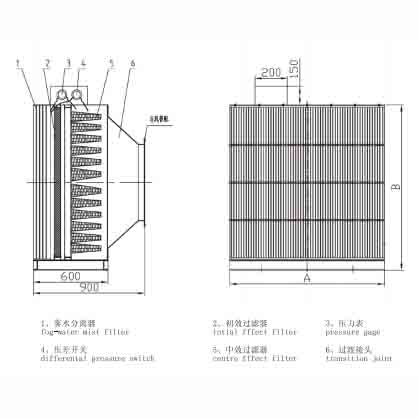
The salt mist filter is mainly composed of a housing, a water mist eliminator, a coarse filter, a middle-effect filter, a transition joint, a pressure gauge, a pressure controller, and other components. The filter material is generally made of stainless steel or galvanized steel, with good corrosion resistance.
In the salt mist filter, the filtrate passes through a multi-stage filtration system, which primarily includes a first-stage (coarse) filter, a second-stage (medium) filter, and a third-stage (high-efficiency) filter.
The filtration principle is generally divided into two forms: mechanical filtration and electrostatic adsorption. Mechanical filtration utilizes the interception effect of the filter material, while electrostatic adsorption uses the electrostatic effect of the filter material to adsorb fine particles. In order to prevent the salt mist from directly entering the cabin, it is necessary to perform multi-stage filtration on the salt mist before it can be directly supplied to the cabin.
The first stage is mainly used to intercept large particles, effectively reducing the load on the subsequent filters. The second stage is used to treat the salt mist that has not been fully filtered by the first stage, further reducing the salt mist content. The third stage is to filter the air that has been filtered by the first two stages to ensure the best filtration effect.
The salt mist filter uses physical separation and mechanical filtration methods to effectively separate water mist and salt mist from the air, thereby ensuring that the salt mist content entering the cabin is within the standard range. It mainly consists of a water mist eliminator and a multi-layer filtration system. The water mist eliminator uses an inertial impact principle or a cyclone separation principle, causing the air flow to rotate at a certain speed in the pipe so that the water mist and salt mist are separated and settled, while the filter material uses a multi-layer structure. It can be divided into coarse, medium, and high-efficiency layers according to different particle sizes, with different separation effects. The salt mist filter has the advantages of simple structure, convenient operation, reliable filtration, and stable performance. It can effectively separate water mist and salt mist from the air. It can be widely used in various fields such as ships, marine engineering, and environmental protection. The equipment has corrosion resistance and high efficiency.
3. Salt mist filtering performance index
-
Flow rate: The initial pressure drop of the salt mist filter is 120 ~ 160Pa, and the final pressure drop is 600Pa.
-
Filtration efficiency: The salt mist filter has an efficiency of 99.97%, and the comprehensive filtration efficiency should exceed 98%.
-
Resistance: The resistance of the salt mist filter is 120 ~ 160Pa.
-
The maximum allowable flow rate of the salt mist filter is 0.8 ~ 1.2m³/s (for each unit area).
-
The filter material of the salt mist filter can be divided into two types: coarse filter and fine filter, and the filtration efficiency can reach 99.97% and 99.99%, respectively.
4. Maintenance of Salt Mist Filter
-
All filters should be replaced when the pressure drop reaches the final working pressure.
-
When the pressure drop reaches the final working pressure, the filters cannot be cleaned for reuse (except for the pre-filters that can be cleaned).
-
When the pressure drop reaches the final working pressure, the filter element must be replaced.
-
The pressure gauge should be checked frequently to ensure that the final pressure drop is not exceeded. Since it is difficult to replace the filters under overload conditions, regular inspection of the equipment is necessary.
5. Determination of the Structural Dimension of Salt Fog Filter
Since the velocity of filter, resistance and overall dimension shall be determined successively according to the inlet and ventilation rate, and the duct and inlet transmission joints of a user, they are subject to the approved drawing. If only to remove the moisture from the air, it is okay to directly use the moisture separator.
6. Outline Drawing of Salt Fog Filter
Note: The dimensional characteristics of the filter are determined by the airflow requirements specified by the user.
(Diagram labels reference):
-
Fog-water mist filter
-
Initial effect filter
-
Pressure gauge
-
Differential pressure switch
-
Centre effect filter
-
Transition joint
Note: A, B dimensions are determined by the wind volume; transition joint dimensions are determined by the internal diameter of the duct.
Note: The description may be different with the product, please contact us for quotation.
Click here to contact us via whatsapp for details
Tag: Our other products