Marine Power Cables: Specialized Electrical Cabling for Ships and Offshore Platforms
Ship power cable is essential components designed specifically for power transmission, lighting, and general control systems aboard river and ocean-going vessels, as well as offshore structures like oil platforms. Classified as specialized cabling for ships and marine facilities, these cables adhere to stringent international standards including IEC 60092-350, IEC 60092-353, and GB 9331-88. Key technical specifications encompass type, number of cores, flame-retardant properties, a rated voltage of 0.6/1 kV, a maximum continuous operating temperature of 85°C, and nominal cross-sectional area. Engineered with oil resistance, moisture resistance, and flame-retardant characteristics, marine power cables perform the critical function of electrical energy transmission and distribution within a vessel’s power system.
Construction and Materials
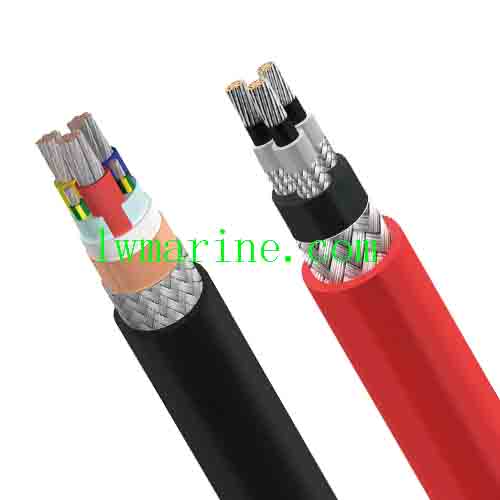
The cable structure comprises four primary layers: conductor, insulation, filler/shielding, and sheath. Conductors are typically made from tinned copper to enhance conductivity and prevent electrochemical corrosion, with non-hygroscopic fillers used in the core. Insulation materials commonly include ethylene-propylene rubber (EPR) or cross-linked polyethylene (XLPE), while the protective sheath is made from thermosetting compounds like chloroprene rubber (CR) or polyvinyl chloride (PVC). Multi-core cables often feature a copper wire braided armor to optimize electric field distribution. For metal-armored types, the minimum bending radius is six times the cable’s outer diameter [1] [4-5] [7]. These products must withstand the harsh demands of the marine environment, including salt spray corrosion, extreme temperatures, and mechanical stress. The product line includes sub-series such as power cables, control cables, and communication cables.
Introduction to Marine Cables
Marine cables connect various electrical devices within a ship’s grid to transmit power or electrical signals. With increasing vessel electrification and automation, the variety and usage of marine cables continue to grow. They are broadly categorized into three types: power cables, communication cables, and special high-frequency cables. Power cables, used for lighting and electrical systems, are the most prevalent on board.
A crucial technical parameter for power cables is current-carrying capacity (ampacity), which largely depends on the thermal endurance rating of the insulation material. Under identical installation conditions, higher temperature ratings allow for greater ampacity. Selecting a cable with an insulation rating too low for a high ambient temperature environment—resulting in a very low permissible temperature rise from current heating—is economically inefficient. The cable sheath must possess properties such as moisture resistance, oil resistance, flame retardancy, and thermal aging resistance. Common sheath materials include chloroprene rubber, chlorosulfonated polyethylene, and PVC, with lead sheaths also used in some applications.
Cable Components in Detail
- Conductor
Copper is the predominant conductor material due to its high electrical conductivity and mechanical strength. To further enhance conductivity and prevent corrosion, individual strands are often tinned. Conductors are classified by manufacturing process into compacted and non-compacted types. Compaction creates a denser structure, saving material and reducing cost, though individual strands lose their perfectly round shape. Except for very small cross-sections, conductors are typically stranded to ensure flexibility, ease of bending, and resistance to insulation damage or plastic deformation. Stranded conductors can be shaped into sectors, circles, or hollow circles. Cables are also classified by the number of cores (e.g., single-core, multi-core), with specific specifications outlined in standards like GB 3956. - Insulation Layer
The quality and standard of the insulation are decisive factors for a cable’s service life. Marine power cables are categorized by common insulation types, as illustrated in Figure 2. The thickness and mechanical properties for each insulation type are strictly defined in standards such as GB 7594. - Filler and Screening Layers
Gaps between the cores in multi-core cables must be filled with a material like non-hygroscopic compound. This filler can be separate from the sheath, extruded integrally with it, or a non-hygroscopic tape can be wrapped between the cores and the sheath. Additionally, cables incorporate screening layers to optimize the internal electric field distribution. Since conductors are stranded, gaps exist between them and the insulation, leading to potential electric field concentration. An inner semiconductor screen addresses this and prevents partial discharge between the conductor and insulation. An outer semiconductor screen equalizes the potential between the insulation and sheath (or armor), ensuring good contact and avoiding partial discharges. - Sheath (Protective Layer)
The protective layer on power cables mainly falls into two types: non-metallic and metallic armored. The varieties and corresponding codes for sheaths are shown in Figure 3. The primary purpose of the sheath is to protect against mechanical damage and environmental factors like oil, salt, and moisture that could compromise the insulation. The performance requirements and usage conditions for various sheaths are also clearly stipulated in GB 7594.
Equivalent Electrical Models
Commonly used structural models for marine power cables include the uniform transmission line model and series-parallel structure models.
- Uniform Transmission Line Model
In this model, the cable is treated as a uniform transmission line where the cross-sectional shape and the electrical/magnetic properties of the dielectric remain constant along its length. Consequently, parameters like line resistance, inductance, and capacitance are uniformly distributed. Although a transmission line is inherently a distributed parameter system, its uniform nature allows it to be described initially using a lumped-parameter model for a small segment (see Figure 4). Here, R represents the distributed resistance per unit length, L the distributed inductance per unit length, G the distributed conductance per unit length, and C the distributed capacitance per unit length. The smaller the segment considered, the more accurately it represents the actual cable’s behavior. - Series-Parallel Structure Model
The conductance of cable insulation material arises from active power losses in the dielectric, primarily including corona loss, dielectric loss, and loss from leakage currents. Since a power cable’s cross-section is typically larger than the minimum required to avoid corona discharge, these losses are usually very small and can often be neglected when determining the cable’s conductance. This simplification leads to basic series and parallel equivalent circuit models for low-voltage cable analysis.
Tag: Our other products
Click here to contact us via whatsapp