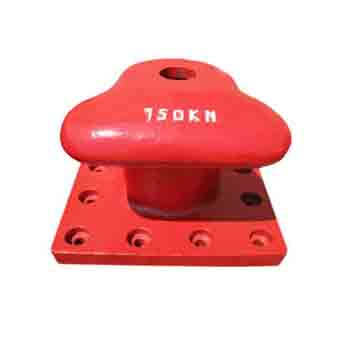
CVI Bollard
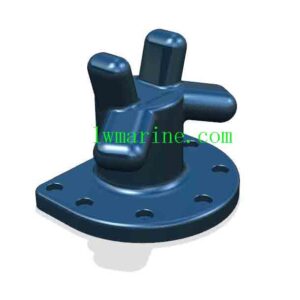
Ensure the highest level of safety and security for berthing operations with our premium CVI Bollard. Engineered as a heavy-duty mooring solution, this bollard is specifically designed for the rigorous demands of modern ports, docks, and marine terminals. Whether accommodating small fishing boats or mid-sized commercial vessels, this bollard provides the reliable holding power necessary for effective ship mooring.
Manufactured from high-grade cast steel, the CVI Bollard offers exceptional strength and durability in the harshest marine environments. Its robust construction is built to withstand constant exposure to saltwater, extreme weather, and the high-impact forces of heavy lines. With a safe working load (SWL) ranging from 10T to 200T, this versatile marine bollard is the ideal choice for securing vessels of various sizes.
Designed for longevity and performance, this cast steel bollard requires minimal maintenance while providing maximum security. It is a critical component for any commercial dock equipment inventory, ensuring that your facility can handle diverse maritime traffic safely and efficiently.
Key Features & Benefits
-
Superior Strength & Durability: Crafted from marine-grade cast steel, this bollard is inherently resistant to corrosion, impact, and the damaging effects of harsh weather. It ensures a long service life with minimal upkeep, reducing total ownership costs.
-
Versatile Load Capacity: With a wide range of load ratings available from 10T to 200T safe working load (SWL) , you can select the exact model required for your specific application, from small boat harbors to busy commercial shipping terminals.
-
Global Certifications & Compliance: Rest easy knowing your mooring hardware meets the highest international standards. The CVI Bollard is certified by leading classification societies including CCS, ABS, BV, LR, NK, and RINA, ensuring full compliance with global marine safety standards.
-
Easy Installation & Maintenance: Designed for practicality, the bollard supports both bolt-down installation on concrete quaysides or embedded installation for a permanent fixture. Its simple, rugged design requires only periodic inspections for upkeep.
-
Optimal Mooring Geometry: The “CVI” profile is specifically shaped to prevent eye splices and mooring lines from jumping off, providing a secure and stable hold during tidal changes and vessel movement.
Technical Specifications
Our CVI Bollards are available in a range of standard sizes to suit various operational needs. Below are the detailed parameters and dimensions.
| Model Type | A (mm) | B (mm) | C (mm) | D (mm) | E (mm) | F (mm) | G (mm) | H (mm) | Safe Working Load (SWL) |
|---|---|---|---|---|---|---|---|---|---|
| CVI-10 | 540 | 600 | 460 | 475 | 250 | 40 | 190 | 360 | 10 Tons |
| CVI-20 | 540 | 600 | 460 | 475 | 250 | 50 | 190 | 370 | 20 Tons |
| CVI-30 | 540 | 600 | 460 | 475 | 250 | 60 | 190 | 380 | 30 Tons |
| CVI-50 | 650 | 700 | 600 | 570 | 300 | 80 | 230 | 450 | 50 Tons |
| CVI-75 | 670 | 800 | 650 | 620 | 340 | 90 | 260 | 510 | 75 Tons |
| CVI-100 | 810 | 1000 | 750 | 710 | 381 | 100 | 300 | 560 | 100 Tons |
| CVI-150 | 810 | 1000 | 750 | 710 | 381 | 100 | 306 | 600 | 150 Tons |
| CVI-200 | 800 | 1080 | 800 | 700 | 430 | 110 | 396 | 600 | 200 Tons |
Frequently Asked Questions (FAQ)
1. What does CVI Bollard stand for?
The “CVI” designation refers to a specific and widely recognized profile design for mooring bollards. It is a double-horn cast steel bollard characterized by its shape, which is optimized to securely hold mooring lines. The “C” and “I” refer to the shape of the horns when viewed from above, designed to prevent lines from slipping or “jumping” off the bollard during vessel movement.
2. What is the difference between a bollard and a cleat?
While both are used for securing lines, they serve different purposes. A bollard, like our CVI model, is a heavy-duty, post-like fixture used on commercial docks, ports, and marine terminals to moor large vessels like ships and barges. A cleat is typically smaller and found on the decks of boats or on smaller private docks for securing smaller watercraft. Bollards are designed for much higher load ratings and industrial use.
3. How do I choose the correct Safe Working Load (SWL) for my dock?
Choosing the correct SWL (Safe Working Load) depends on the maximum size and displacement of the vessels that will be moored at your facility. You must consider the mooring forces generated by wind, current, and tides. As a general rule, the bollard’s SWL should exceed the expected line pull from the largest vessel. For specific engineering recommendations based on your port’s traffic, please contact us with your vessel details.
4. What is the advantage of cast steel over cast iron for marine bollards?
Cast steel offers superior mechanical properties compared to cast iron. It has higher tensile strength, greater ductility (ability to deform without breaking), and much better impact resistance. This makes cast steel bollards far more reliable in a heavy-duty mooring environment where sudden shock loads from vessel movements can occur. Steel is also more weldable and repairable if ever damaged.
5. What are the installation options for this bollard?
Our CVI Bollard is designed for two primary installation methods to suit different quay constructions:
-
Bolt-Down Installation: The bollard is secured to the dock surface using heavy-duty anchor bolts embedded into the concrete. This is common for retrofitting or on existing quays.
-
Embedded Installation: The base of the bollard is set directly into the wet concrete during the construction of a new quay wall or dock. This provides an exceptionally strong, permanent fixture.
The dimensions in the technical table (like the base plate and bolt hole patterns) facilitate both methods.
Attention please: The description was copied from different cooperating manufacturers. The description may be different with the goods, please check with us when order.
Tag: Our other products
Click here to contact us via whatsapp