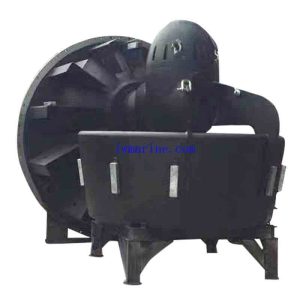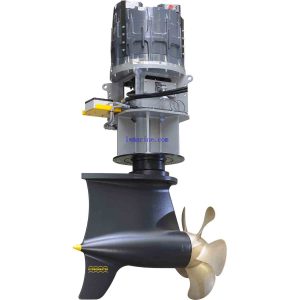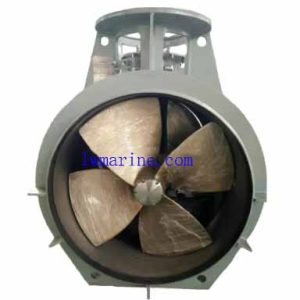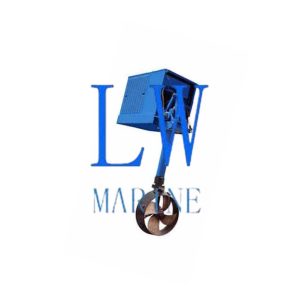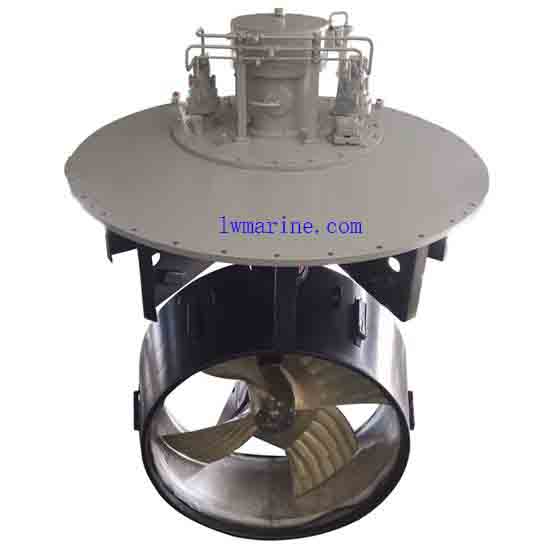
Marine Controllable Pitch Azimuth Thruster
The Marine Controllable Pitch (CP) Azimuth Thruster represents the pinnacle of propulsion technology, seamlessly combining real-time blade pitch adjustment with full 360° directional thrust. This advanced integrated system empowers captains with pinpoint maneuverability while simultaneously optimizing fuel efficiency across all operating speeds, from transit to dynamic positioning.
By decoupling engine speed from thrust output, the CP propeller system allows for instant, precise control of thrust magnitude and direction, all while the prime mover runs at its most efficient RPM. When combined with the 360° azimuthing capability, this thruster eliminates the need for traditional rudders and enables true vessel omni-directional movement, including sideways translation and rotation on the spot.
Where CP Azimuth Thrusters Excel
This advanced propulsion solution is the preferred choice for the most demanding vessel types:
-
✔ Dynamic Positioning (DP) Vessels: Provides the instant thrust response and precise station-keeping required for DP class 2 and 3 operations.
-
✔ Offshore Support Ships: Enables precise positioning relative to offshore platforms and rigs, even in challenging sea states.
-
✔ Tugboats & Ferries: Delivers the superior docking control and bollard pull needed for safe, efficient harbor maneuvers.
-
✔ Research & Survey Vessels: The system’s low-noise operation is critical for acoustic surveys and sensitive marine research.
Smart Features for Superior Performance: The Dual-Control Advantage
This thruster combines two independent control technologies into one cohesive system, offering capabilities unattainable by fixed-pitch or steerable propeller systems alone.
✅ 1. The CP Propeller System (Controllable Pitch)
Instead of changing vessel speed by increasing or decreasing propeller RPM (like a fixed-pitch prop), the CP system alters the angle (pitch) of the propeller blades.
-
Instantaneous Thrust Response: Change from full ahead to full astern in seconds without changing shaft rotation direction.
-
Optimal Efficiency at Any Speed: Maintain the prime mover at optimal RPM while adjusting blade pitch to match the exact thrust required, resulting in 15-25% better fuel efficiency compared to fixed-pitch propellers, especially in vessels with varying operational profiles (transit, towing, loitering).
-
Precise Load Control: Prevents engine overloading and allows for fine-tuned thrust for delicate maneuvering.
✅ 2. Full 360° Azimuth Rotation
The entire thruster unit rotates continuously around a vertical axis.
-
360° Thrust Vectoring: Direct the full power of the propeller in any direction instantly.
-
Eliminates Rudders: Reduces drag and simplifies the underwater hull form.
-
Omni-Directional Maneuvering: Enables true sideways movement, diagonal translation, and rotation on the vessel’s own axis.
Configuration Options: Tailored to Your Vessel
We understand that every vessel has unique requirements. Our CP Azimuth Thrusters are available in a wide range of configurations.
Drive Types:
-
🔹 L-Drive (Compact): Features a right-angle gear arrangement, ideal for installations with limited vertical space.
-
🔹 Z-Drive (Heavy-Duty): Features a double-bend gear arrangement, offering robust construction and easy maintenance access, preferred for high-power applications like tugs.
Power Options:
-
🔹 Electric Motor Drive: For zero-emission zones, silent operation, and integration with diesel-electric or battery-hybrid power plants.
-
🔹 Hydraulic Drive: Offers flexible prime mover placement and smooth, high-torque power delivery.
-
🔹 Direct Diesel Drive: For simple, robust installations where a direct mechanical connection is preferred.
Installation Flexibility:
-
🔹 Transom Mounting: Ideal for retrofits and workboats.
-
🔹 Well / Tunnel Mounting: For retractable or fixed installations through the hull.
-
🔹 Deck Mounting: For specialized applications like barges or pontoons.
Technical Specifications & Model Selection
Select the ideal thruster based on your vessel’s power requirements and physical constraints.
| Model | Max. Input Power (KW / HP) | Propeller Diameter (mm) | Max. Input Torque (N.m) | Max. Input Speed (r/min) | Reduction Ratio (Total) |
|---|---|---|---|---|---|
| RP20 | 45 / 61 | Up to 500 | 200 | 2300 | 1.93 |
| RP42 | 100 / 135 | Up to 800 | 420 | 2500 | 2.5 |
| RP85 | 210 / 286 | Up to 950 | 850 | 2350 | 2.65 |
| RP168 | 300 / 400 | Up to 1150 | 1675 | 2000 | 3.46 |
| RP300 | 480 / 650 | Up to 1550 | 2800 | 1800 | 3.96 |
| RP330 | 620 / 843 | 900 – 1250 | 3300 | 1800 | 4.04 |
| RP550 | 920 / 1250 | 900 – 1250 | 5423 | 1800 | 5.059 |
| RP1470 | 1250 / 1700 | Up to 2100 | 14740 | 1000 | 3.257 |
| RP1950 | 1650 / 2244 | Up to 2300 | 19500 | 1000 | 3.58 |
Note: PAL (Overall Length) varies by configuration and reduction ratio. Please consult our engineering team for detailed dimensional drawings.
Key Benefits Summary
-
✔ Ultimate Maneuverability: 360° thrust combined with instant pitch response.
-
✔ Significant Fuel Savings: 15-25% efficiency gains over fixed-pitch systems.
-
✔ Exceptional Station Keeping: Ideal for high-spec Dynamic Positioning (DP) operations.
-
✔ Versatile Configurations: L-Drive or Z-Drive; Electric, Hydraulic, or Diesel.
-
✔ Reduced Machinery Wear: Smoother operations and reduced shock loading on the drivetrain.
-
✔ Low Noise & Vibration: Enhanced crew comfort and suitability for acoustic research.
Frequently Asked Questions (FAQs)
Q1: What is the fundamental difference between a Controllable Pitch (CP) propeller and a Fixed Pitch (FP) propeller in an azimuth thruster?
A: In an FP system, you control thrust by changing the propeller’s rotational speed (RPM) and direction. To go from forward to reverse, you must stop the shaft and spin it the other way. In a CP system, the propeller shaft rotates continuously in one direction at an optimal speed. You control thrust magnitude and direction by changing the angle (pitch) of the blades. This allows for instant thrust reversal and precise, incremental thrust control without changing engine or motor speed.
Q2: How much fuel can I realistically save with a CP Azimuth Thruster?
A: The fuel savings are most significant for vessels with varying operational profiles. For example, a tugboat that spends time transiting, towing at low speed, and maneuvering in a harbor can see fuel savings of 15-25% compared to a fixed-pitch system. This is because the prime mover can run at its most efficient, constant speed while the blade pitch is adjusted to match the exact thrust required for each task, rather than throttling the engine up and down.
Q3: What is the difference between an L-Drive and a Z-Drive configuration?
A: Both allow for 360° rotation, but they route the power differently:
-
L-Drive: The input shaft (from the motor/engine) is horizontal. It connects to a vertical shaft via a single right-angle gear (forming an “L”). This is a compact design, often used when vertical space in the hull is limited.
-
Z-Drive: The input shaft is horizontal, connected to a vertical shaft via an upper gearbox, which then connects to a horizontal propeller shaft via a lower gearbox (forming a “Z”). This design is typically more robust and allows for easier maintenance access to the upper gearbox, making it popular for high-power applications like tugs.
Q4: Why is a CP Azimuth Thruster preferred for Dynamic Positioning (DP) vessels?
A: DP systems require the ability to make very small, instant, and precise changes in thrust to maintain a vessel’s position against wind, waves, and current. A CP azimuth thruster is ideal because:
-
Instant Thrust Response: Blade pitch can change much faster than motor speed, allowing the DP controller to counteract forces immediately.
-
Fine Thrust Control: The system can produce very small net thrust increments by adjusting blade pitch slightly, whereas an FP system might require a larger, less precise RPM change.
-
Rapid Thrust Reversal: The ability to go from forward to reverse thrust instantly is critical for maintaining position.
Q5: Can I retrofit a CP Azimuth Thruster to my existing vessel?
A: Yes, retrofitting is possible, particularly with transom-mount or under-slung configurations that minimize hull modifications. However, a retrofit requires a detailed engineering study to assess the vessel’s structure, power generation (or hydraulic take-off) capacity, and control system integration. Our engineering team can conduct a feasibility study for your specific vessel.
Q6: What does “PAL Length” refer to in the specification table?
A: PAL typically refers to the overall length of the thruster unit from the top of the mounting flange/gearbox to the bottom of the propeller skeg or the lowest point. This is a critical dimension for determining if the thruster will fit within the hull’s vertical space or below the vessel’s baseline draft. The range (Min/Max) accounts for different reduction ratios and configurations within a model series.
Attention please: The description was copied from different cooperating manufacturers. The description may be different with the goods, please check with us when order.
Tag: Our other products
Click here to contact us via whatsapp