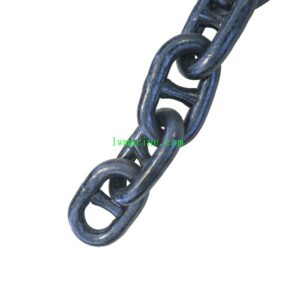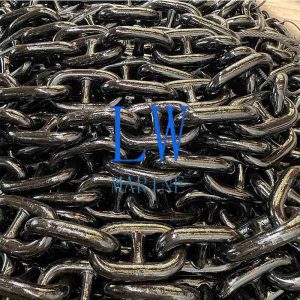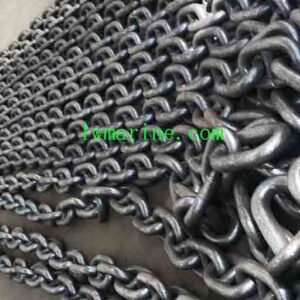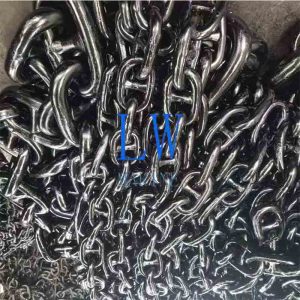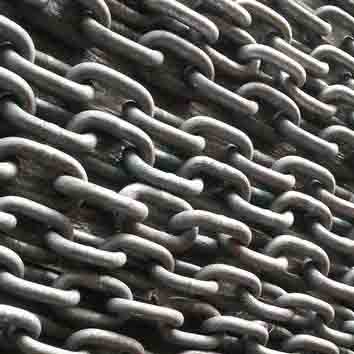
R3 Grade Mooring Chain
Engineered for the most demanding long-term deployments, our R3 Grade Mooring Chain sets the benchmark for reliability in permanent offshore installations. Unlike standard anchor chains designed for temporary ship anchoring, this high-strength offshore mooring chain is purpose-built to withstand the relentless forces of deepwater environments for decades. It is the trusted choice for critical infrastructure requiring uncompromising safety and performance.
From oil & gas platforms and Floating Production Storage and Offloading (FPSO) vessels to subsea infrastructure moorings and the next generation of renewable energy installations like floating wind farms and tidal systems, our R3 chain provides the foundational security these projects demand.
Built to endure decades of continuous use, this deepwater mooring chain offers:
-
✔ Exceptional Tensile Strength: As a true R3 grade, it significantly exceeds standard marine chain specifications, providing the muscle for massive floating structures.
-
✔ Superior Fatigue Resistance: Specifically engineered for dynamic loading conditions, it withstands the constant stresses of waves, currents, and vessel motion without failure.
-
✔ Enhanced Corrosion Protection: Designed with advanced coatings and compatibility with cathodic protection systems to resist long-term seawater deterioration.
-
✔ Proven Wear Resistance: Metallurgically formulated to handle constant interaction with the seabed and fairleads, ensuring long service life.
Key Differentiators: R3 Mooring Chain vs. Standard Anchor Chains
Understanding the difference between a mooring chain and an anchor chain is critical for project safety. Here is how our offshore platform chain compares to standard alternatives:
| Feature | R3 Mooring Chain | Standard Anchor Chain |
|---|---|---|
| Primary Use | Permanent offshore installations (FPSOs, Rigs) | Temporary ship anchoring (vessels, boats) |
| Load Profile | Constant tension + dynamic fatigue | Intermittent shock loading |
| Material Spec | Special alloy steel with high toughness at low temps | High-tensile carbon steel |
| Corrosion Resistance | Advanced coatings + designed for cathodic protection | Basic galvanization or painting |
| Certification | API 2F, DNV-OS-E302, etc. | ABS, LR, NK, etc. (for shipboard use) |
R3 Mooring Chain Technical Parameters
Below are the detailed specifications for our range of offshore mooring chain, including breaking loads and tension ratings for various diameters. Please note the values for Breaking Load, Stud Tension, and Studless Tension are provided in kN.
| Chain Diameter (mm) | Breaking Load (kN) | Stud Tension (kN) | Studless Tension (kN) |
|---|---|---|---|
| 34 | 1308 | 745 | — |
| 36 | 1461 | 832 | — |
| 38 | 1621 | 923 | — |
| 40 | 1789 | 1019 | — |
| 42 | 1965 | 1119 | — |
| 44 | 2148 | 1223 | — |
| 46 | 2338 | 1331 | — |
| 48 | 2536 | 1444 | — |
| 50 | 2740 | 1560 | — |
| 52 | 2952 | 1681 | — |
| 54 | 3171 | 1806 | — |
| 56 | 3396 | 1934 | — |
| 58 | 3628 | 2066 | — |
| 60 | 3867 | 2202 | — |
| 62 | 4112 | 2342 | — |
| 64 | 4364 | 2485 | — |
| 66 | 4622 | 2632 | — |
| 68 | 4886 | 2782 | — |
| 70 | 5156 | 2936 | — |
| 73 | 5572 | 3173 | — |
| 76 | 6002 | 3417 | — |
| 78 | 6295 | 3584 | — |
| 81 | 6746 | 3841 | — |
| 84 | 7208 | 4104 | — |
| 87 | 7682 | 4374 | — |
| 90 | 8168 | 4651 | — |
| 92 | 8498 | 4838 | — |
| 95 | 9002 | 5125 | — |
| 97 | 9343 | 5320 | — |
| 100 | 9864 | 5616 | — |
| 102 | 10217 | 5817 | — |
| 105 | 10755 | 6123 | — |
| 107 | 11118 | 6330 | — |
| 111 | 11857 | 6751 | — |
| 114 | 12421 | 7072 | — |
| 117 | 12993 | 7398 | — |
| 120 | 13573 | 7728 | — |
| 122 | 13964 | 7951 | — |
| 124 | 14358 | 8175 | — |
| 127 | 14956 | 8515 | — |
| 130 | 15559 | 8859 | — |
| 132 | 15965 | 9090 | — |
| 137 | 16992 | 9674 | — |
| 142 | 18034 | 10268 | — |
| 147 | 19089 | 10869 | — |
| 152 | 20157 | 11476 | — |
| 157 | 21235 | 12090 | — |
| 162 | 22321 | 12708 | — |
Frequently Asked Questions (FAQs)
Q1: What is the main difference between an R3 mooring chain and a standard ship’s anchor chain?
A: The core difference lies in the intended use and design philosophy. A standard anchor chain is designed for intermittent use, holding a vessel temporarily against wind and current. An R3 mooring chain is engineered for permanent offshore installations. It is made from a special alloy steel with higher toughness and is specifically designed to withstand constant tension and dynamic fatigue from waves and currents over many years, not just occasional shock loads.
Q2: Is this R3 chain suitable for use in a floating offshore wind farm mooring system?
A: Yes, absolutely. R3 grade is a very common and suitable choice for renewable energy installations like floating wind farms and tidal energy systems. Its combination of strength, fatigue resistance, and proven performance makes it ideal for these dynamic and long-life projects. For specific water depths and environmental conditions, higher grades (R3S, R4, R4S) may also be considered, but R3 is a robust and cost-effective starting point for many projects.
Q3: What certifications are available for your R3 mooring chain?
A: Our offshore mooring chain is manufactured to meet the most stringent industry standards. It is available with certification from major classification societies, including API 2F, DNV-OS-E302, ABS, BV, LR, CCS, and NK. These certifications provide full traceability and documented proof that the chain meets the required mechanical and chemical properties for offshore use.
Q4: What does “Stud Tension” mean in the specifications table?
A: “Stud Tension” refers to the maximum recommended tension for a stud-link mooring chain. A stud-link chain has a solid bar (the “stud”) across the width of each link. This stud increases the link’s strength, prevents it from deforming under load, and improves handling. The Stud Tension value (in kN) is a critical design parameter representing the chain’s capacity in this specific configuration.
Q5: How does the R3 chain resist corrosion over decades in saltwater?
A: Corrosion resistance is achieved through a multi-faceted approach. First, the special alloy steel itself has inherent properties that aid in longevity. Second, the chain is often supplied with advanced coatings. Most critically, R3 mooring chains are designed to be integrated into a cathodic protection system on the offshore structure. Sacrificial anodes are connected to the mooring line, which prevents the chain itself from corroding by making it the cathode in an electrochemical cell.
Q6: What is the difference between R3, R3S, and R4 grades?
A: These grades represent increasing levels of strength and are defined by their minimum tensile and yield strengths. R3 is a robust grade suitable for many deepwater applications. R3S has a higher strength than R3 but is not quite as high as R4. As you move up the grades (R3 -> R3S -> R4 -> R4S -> R5), the steel becomes progressively stronger, allowing for the use of smaller diameter chains to hold the same load, which is critical for reducing weight in ultra-deepwater projects. The choice depends on the specific design loads and water depth.
Attention please: The description was copied from different cooperating manufacturers. The description may be different with the goods, please check with us when order.
Tag: Our other products
Click here to contact us via whatsapp